
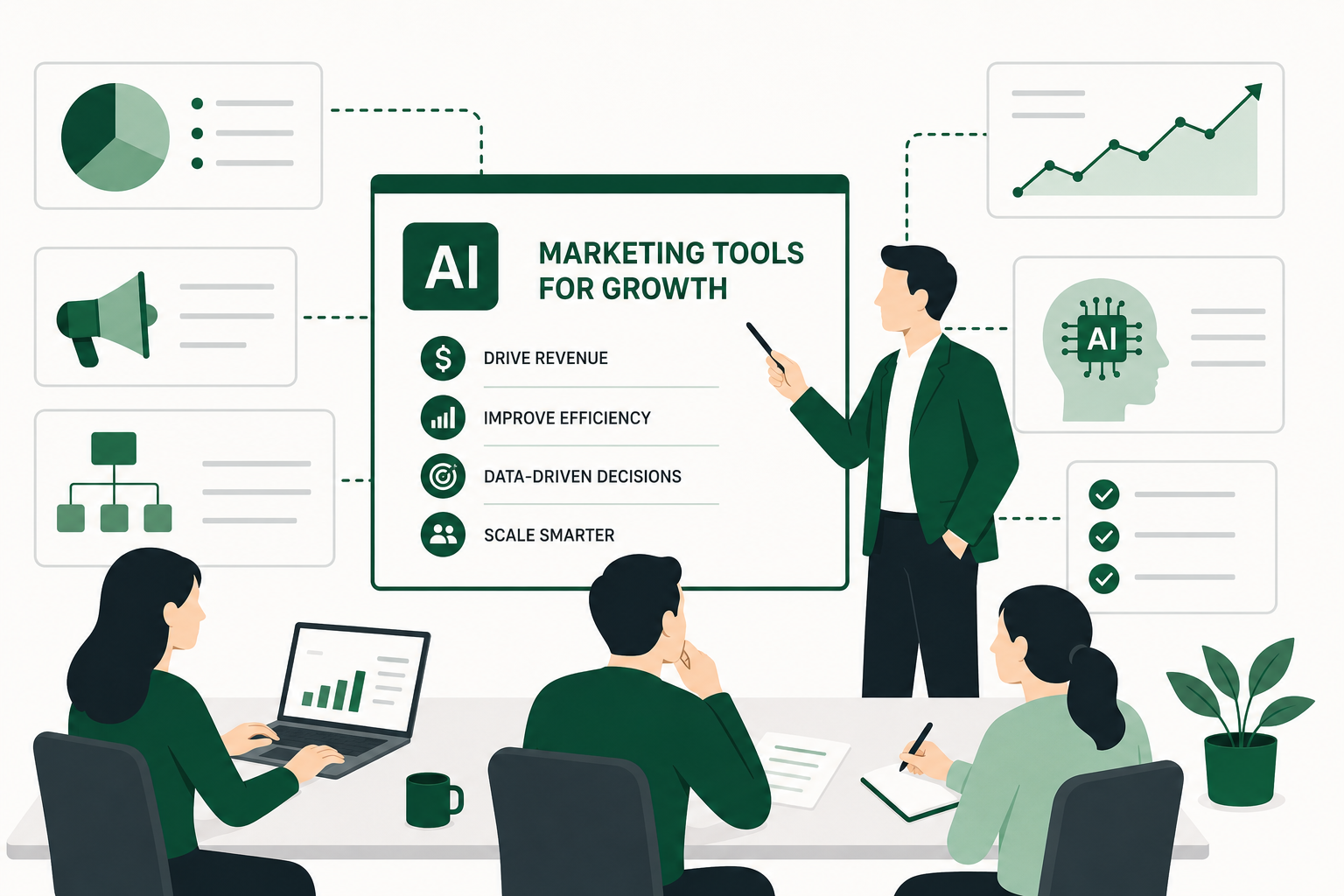
The hard part of bringing AI into marketing is almost never the tool. It’s the room where the budget gets signed off. Your leadership team hears the word “AI” a dozen times a day, and they know most of it is noise. The work is making your case sound specific, costed, and tied to a problem they already feel. Here’s how you can pitch AI marketing tools like Agentcy to your managerial team.
Lead with the Problem, Not the Product
Walk into the meeting talking about the tool and you’ve already lost. Executives don’t buy software. They buy outcomes, and they fund fixes for problems they can name.
So name the problem first. Not “we’d like to try an AI platform.” Try this instead: “We spend [X] a year on agencies. A campaign takes three weeks to turn around. We can cut both with Agentcy.” Same request. Completely different meeting.
You can also highlight time spent on a task. For example: “We’ve spent 30 hours this month on building, managing, and optimizing campaigns. We can cut that time down to 10 hours with Agentcy.”
The tool comes up at the end as the answer, not the headline.
Learn What Each Seat Actually Cares About
“The C-suite” is not one audience. It’s three or four people with different fears and different scorecards. Your pitch lands when each of them hears their own concern answered.
- The CEO cares about growth without adding cost, and about not falling behind competitors who move faster. Give them the strategic version: more output, more channels, the same headcount.
- The CFO cares about predictable spend and the downside if it doesn’t work. They have lived through agency retainers that creep every quarter. A fixed monthly cost they can forecast isn’t a risk to them, but a relief.
- The marketing lead cares about output, speed, and keeping control of the brand. Their real worry is being handed a tool that publishes off-brand work nobody approved. Answer that one head-on, focusing on use cases and safety nets.
Map every line of your pitch to one of these people. If a point doesn’t answer someone in the room, cut it.
Bring a Number They Can’t Argue With
The most persuasive number in the meeting is your own. Pull your last twelve months of agency invoices or internal statistics: retainers, project fees, media management fees, the rush charges. Put a turnaround time next to each deliverable. That single page does more than any vendor case study, because it’s about your money and your timeline.
Then show what the same work costs on a fixed monthly plan. The gap is your business case. You don’t have to oversell it; the numbers do the talking, which is exactly the tone a CFO trusts.
If you want a starting figure, the savings calculator turns your current spend into a wasted-spend number and an estimated saving in about a minute. Bring the output to the meeting.
Answer the Four Most Common Objections Before They Ask
You already know what leadership will push back on. Get there first.
- “AI makes things up.”
True, which is why nothing should publish on its own. With Agentcy, every action that writes to a live channel routes through an approval step. The platform drafts, and then a person signs off. Human-in-the-loop isn’t a setting you switch on. It’s how it works by default. - “This tool replaces our team.”
It doesn’t. It replaces overhead. Your team stops waiting on a vendor or stops wasting time on manually completing tasks and starts shipping the work itself, with more reach than before. The headcount you have goes further. That’s the pitch, not fewer people. - “This tool isn’t secure.”
Fair question, and the right move is to ask it of any vendor. Where is the data stored? Who can access it? What happens to it on cancellation? Bring those questions to the table and ask for the provider’s security documentation in writing. Treat a straight answer as the bar. - “It’s a trend, this won’t be useful in 12 months.”
AI in marketing isn’t one thing. It’s a set of specific jobs. Writing ad variants, drafting briefs, watching campaign performance overnight. You’re not betting the company on a trend. You’re handing well-defined tasks to software that’s good at them, and keeping the judgment with your team.
Make the Ask Small
Don’t ask for a transformation. Ask for one channel and one metric. Pick the workflow that’s costing the most or moving the slowest, set a number that defines success, and run it for a defined period on a known cost. A small, measurable yes is easier to give than a big, vague one, and it gives you proof for the next conversation.
This is also why a fixed price matters. An agency retainer is open-ended by design; you never quite know the ceiling. A subscription is a line item your CFO can read at a glance. The commitment is bounded, the number is fixed, and the comparison writes itself.
Your One-Page Business Case for AI Marketing Software
Keep it to a single page. Leadership reads one page; they skim ten. That’s the whole document. If you can’t fit it on a page, the pitch isn’t ready yet. Use this:
| The Problem | One sentence, in their language. Cost, speed, or capacity. |
| Current Cost | Your real agency spend and turnaround from the invoices or your actual internal hours and ad spend. |
| The Proposed Fix | What changes, and on what timeline. |
| Success Metric | The one number that says this worked. |
| The Ask | Exactly what you need approved, and for how long. |
Where Agentcy Fits
Agentcy is built for exactly this conversation. The premise is in the name; like an agency, without the agency. Your team gets a roster of AI agents for the work an agency would do — paid ads, content, SEO, email, strategy, and reporting — on a fixed monthly cost instead of a retainer.
Every agent drafts, but nothing reaches a live channel without your approval. Your brand, your accounts, your call. For a CFO, it’s a predictable number. For a marketing lead, it’s capacity without losing control. For a CEO, it’s more output without more cost. That’s an easy thing to say yes to, which is the point.
Frequently Asked Questions About Pitching AI Tools in Marketing
What’s the single most important thing to lead with?
Always lead with a problem and a number, not the technology. Open with what AI is going to fix (cost, speed, or capacity) and what that’s worth to the business. The tool is the answer to the problem, not the opening line.
Won’t leadership think AI is replacing our marketing team?
If you’re currently paying an agency, it replaces the agency, not the team. The work moves in-house, your existing people ship more of it, and the spend that used to leave the building stays in it.
If your marketing operates in-house, it’s cutting the lead time and manual work. Your team is still important; their strategy, brand knowledge, and quality goals are all essential to ensuring the tool supports growth.
Frame it as capacity, not cuts.
How do I answer security and IT questions?
Ask the standard questions of any vendor: where data is stored, who can access it, and what happens on cancellation. Request the provider’s security documentation in writing. Bring IT in early; a stalled security review ends more deals than a weak demo.
How small can we start?
As small as one channel and one metric. Pick the most expensive or slowest workflow, define what success looks like, and run it on a fixed cost for a set period. Agentcy is designed to support businesses of all sizes, from multi-brand corporations to local organizations.
Elevate Your Marketing Capabilities with Agentcy
A budget conversation is won on clarity, not enthusiasm. Lead with the problem your leadership already feels, put a real number beside it, and keep the ask small enough to approve in a single meeting. Do that, and AI stops sounding like a trend and starts sounding like a decision.
Agentcy is the version of that decision that’s hard to argue with: agency-level output, a fixed monthly cost, and a person signing off on everything before it goes live. Get the number first. Then let it make your case.
Use our pricing calculator to pitch it, then request access to get started right way.